Peri-Implantitis: Diagnosis, Implant Surface Decontamination and Surgical Bone Regeneration — Evidence-Based Protocols 2024
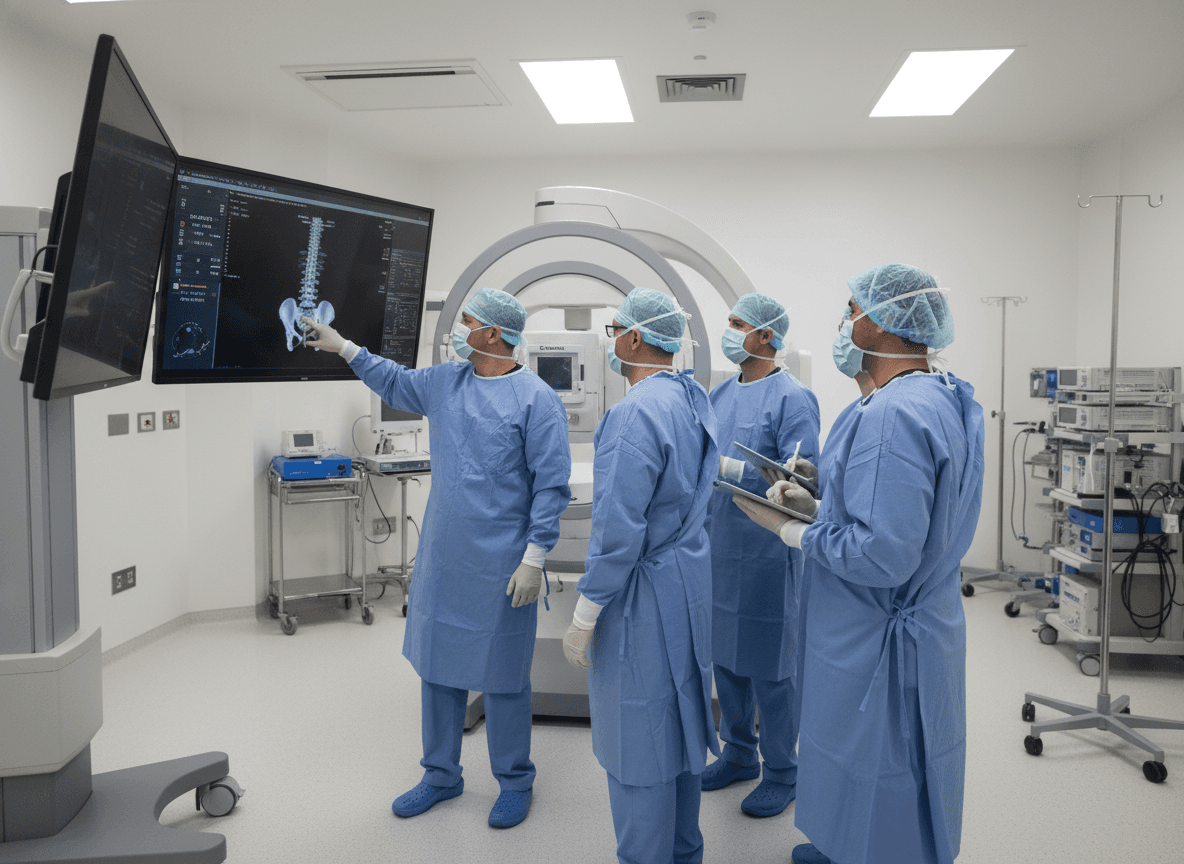
Peri-implantitis affects 22% of implants and 43% of implant-treated patients at 10 years. Its surgical management — implant surface decontamination, peri-implant GBR and biomaterial selection — determines long-term prognosis.
Peri-implantitis is defined as an infectious inflammatory condition affecting peri-implant tissues (mucosa + bone), characterised by marginal bone level loss ≥ 2 mm, positive bleeding on probing (BOP) and/or suppuration, probing depth ≥ 5–6 mm. Its prevalence is alarming: 22% of implants individually and 43% of patients at least one implant at 10 years (Derks & Tomasi, meta-analysis, Journal of Clinical Periodontology, 2015 — updated Schwarz et al. 2024). Surgical management — indicated once conservative treatment (ultrasonic debridement + local antisepsis) fails — rests on three pillars: surgical access to the defect, implant surface decontamination, and the regenerative or resective decision.
1. Classification of Peri-Implant Bone Defects
The Schwarz et al. classification (2022, adopted by EAO) is the reference for describing peri-implant bone defects and guiding therapeutic decision: Class I — Intrabony defect (supracrestal circular or funnel-shaped bony defect): favourable for regeneration. Class Ia: > 3 bony walls. Class Ib: 2 walls. Class Ic: 1 wall or circular defect. Class II — Supracrestal defect (horizontal bone loss): not favourable for regeneration, resective treatment indicated. This distinction is fundamental: a Class Ia infrabony defect has a regeneration predictability of 70–85%, whereas a supracrestal defect will derive no benefit from a regeneration attempt.
2. Implant Surface Decontamination: The Key to Regeneration
Decontamination of the implant surface contaminated by bacterial biofilm is the indispensable prerequisite for any regeneration attempt. No technique has demonstrated universal superiority; current consensus advocates a combination of methods. Mechanical methods: plastic or titanium curettes (do not scratch the implant), glycine abrasive systems (air-abrasion — AIR-FLOW Handy 3.0 peri-implant), titanium or carborundum brushes. Chemical methods: concentrated citric acid at 40% (30 s) — surface charge modification; chlorhexidine digluconate 0.12–0.2% irrigation; sterile saline copious lavage. Physical methods: Er:YAG laser (parameters: 100 mJ, 10 Hz, radial fibre, slight superficial vaporisation without implant ablation) — thermal biofilm degradation without documented implant damage; photodynamic therapy (PDT) — rose bengal or methylene blue + 670 nm laser. A network meta-analysis (Suárez-López Del Amo et al., JOMI 2024) concludes clinical equivalence of combined mechanical, chemical and physical methods — none superior alone.
| Decontamination protocol | BOP reduction at 12 months | Probing depth reduction | Evidence level | Relative cost |
|---|---|---|---|---|
| Plastic curettes + CHX 0.2% | 52% | −1.8 mm | Level I | Low |
| Glycine air-abrasion (peri-implant AIR-FLOW) | 61% | −2.1 mm | Level I | Medium |
| Er:YAG laser | 58% | −2.0 mm | Level II | High |
| Photodynamic therapy (PDT) | 55% | −1.9 mm | Level II | Medium |
| Combined mechanical + chemical + physical | 74% | −2.5 mm | Level I | High |
3. Peri-Implant Bone Regeneration: Biomaterials and Results
For intrabony defects (Schwarz Class I), peri-implant GBR after decontamination is the recommended therapeutic approach. The most documented biomaterials are bovine xenograft (Bio-Oss®) and allografts (DFDBA), used alone or in combination with bioresorbable collagen membrane. A meta-analysis by Ravidà et al. (JCP 2024, 31 RCTs, n = 1,842 defects) reports defect resolution (defined as ≥ 50% reduction in infrabony depth) in 64.7% of GBR-treated cases vs 32.1% for debridement alone (p < 0.001). Mean radiological bone gain: 2.1 mm (GBR) vs 0.9 mm (debridement alone). GBR success in peri-implantitis is correlated with defect morphology (Class Ia > Ib > Ic), implant surface decontamination quality, and absence of active smoking (failure Odds Ratio: 2.8 in smokers vs non-smokers — Schwarz et al. 2024).
4. Reference Surgical Protocol (EAO Consensus 2024)
- Local anaesthesia, crestal access incision and vertical releases if necessary — full-thickness flap
- Complete defect exposure — evaluation of morphology (Schwarz classification), bone loss measurement by direct bone probing
- Granulectomy — removal of all peri-implant granulation tissue with curette (chronic inflammatory tissue mass)
- Exposed implant surface decontamination — sequence: plastic curettes → glycine air-abrasion 30 s → copious 0.9% NaCl irrigation → citric acid 40% application 30 s → final irrigation
- Regenerative decision (Schwarz Class I) or resective (Class II) — if regenerative: Bio-Oss® xenograft filling ± DFDBA allograft + double-layer Bio-Gide® collagen coverage
- Tension-free closure (deep flap release if necessary) — non-resorbable Prolene 5-0 or Vicryl 4-0 sutures
- Systemic antibiotics: amoxicillin 500 mg × 3/day for 7 days OR metronidazole 500 mg × 3/day if penicillin contraindication
- Reinforced post-surgical maintenance: review D7, D14, 1 month, 3 months, 6 months, annual — essential for result sustainability
Peri-implantitis is not a surgical inevitability. Early diagnosis, rigorous decontamination and GBR adapted to the defect morphotype allow 65–75% of cases to be stabilised with durable 5-year results — provided regular and irreproachable professional maintenance is ensured.
— Schwarz F. et al., Journal of Clinical Periodontology, 2024
Editorial note
This article is written for scientific and professional monitoring purposes. The studies cited are drawn from peer-reviewed publications. Infinity Aligner does not endorse the results of third-party studies and recommends that professionals consult the original publications for any clinical application.
Infinity Aligner — Scientific team
Technology watch & dental literature review
More analyses
Mar 2026
Photobiomodulation (LLLT) and Bone Healing in Implantology: Clinical Evidence, Dosimetry Protocols and 2024 Post-surgical Applications
Mar 2026
Osteodensification and Bone Condensation in Implantology: Versah Technique, Condensation Osteotomes and Bone Quality Improvement Protocols in D3–D4 Bone
Mar 2026
Vertical Bone Augmentation in Implantology: Titanium Mesh (TiMesh), Alveolar Distraction Osteogenesis and Reinforced Membrane — Advanced Techniques, Learning Curves and Compared Results
Integrate innovation into your practice
Join the Infinity Aligner network and access the most advanced digital tools for your patients.
Become a partner