What You Can (and Cannot) Eat With Clear Aligners
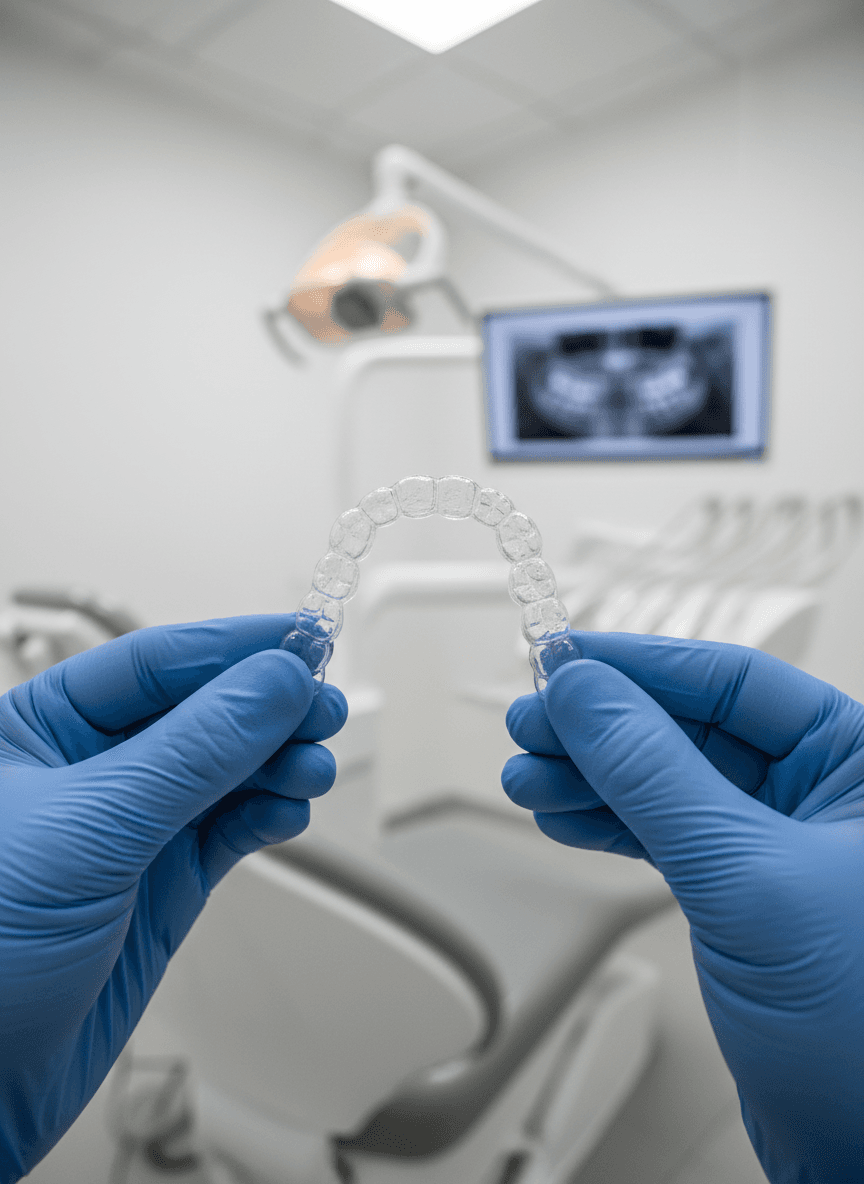
Coffee, tea, wine, sugar, hard foods: a complete guide to eating during aligner treatment. Table of allowed and foods to avoid, practical tips to protect your aligners.
One of the first questions patients ask at the start of a clear aligner treatment is simple: do I need to change the way I eat? The answer is nuanced. Unlike fixed orthodontic braces, aligners are removed for meals — which theoretically means you can continue eating normally. But "theoretically" is the key word. Certain dietary habits can compromise treatment effectiveness, degrade the aligners or increase the risk of cavities. This guide gives you the essential rules.
1. The Golden Rule: Never Eat With Aligners In
Clear aligners are made of thermoplastic — a resistant material that is not designed to withstand chewing forces. Eating with aligners in place exposes you to three major risks: mechanical deformation (cracks, distortions) that compromises the precision of the programmed tooth movement; accumulation of food residue between the aligner and teeth (an ideal environment for cariogenic bacteria); and irreversible staining of the aligners by pigmented foods. The rule is absolute: remove aligners before every meal, snack or drink other than cold water.
2. Beverages: The Most Common Trap
The vast majority of aligner degradation seen in clinics does not come from meals — but from beverages consumed with aligners in place, often out of habit or forgetfulness. Here is what you need to know:
| Beverage | Compatible with aligners? | Main risk | Recommendation |
|---|---|---|---|
| Cold water (still or sparkling) | Yes ✅ | None | Only beverage allowed with aligners in |
| Hot water / herbal teas | No ❌ | Thermal deformation of plastic | Remove aligners |
| Coffee / tea | No ❌ | Irreversible staining + deformation if hot | Remove, drink, rinse teeth, replace |
| Red / rosé wine | No ❌ | Intense pigmentation, permanent staining | Always remove |
| Sodas / fruit juices | No ❌ | Sugar trapped against teeth = high cavity risk | Remove, drink with straw, rinse |
| Smoothies / milkshakes | No ❌ | Sugary, acidic residue, difficult to rinse | Always remove |
| Spirits / strong alcohol | No ❌ | Thermoplastic degradation (solvent effect) | Remove aligners |
3. Diet and Attachments (Buttons)
If your treatment includes attachments (small composite buttons bonded to teeth to assist certain movements), some foods can exert forces that risk detaching them. Foods particularly risky for attachments include hard, crunchy foods (very crusty bread, hard sweets, nuts, raw carrots), sticky foods (chewing gum, caramel, nougat) that can create traction on the attachment, and very firm foods bitten edge-on (apple bitten directly). The solution: cut food into small pieces and chew laterally, avoiding significant frontal biting pressure.
4. The Meal Window: How to Optimise Aligner Wear
The treatment protocol recommends a minimum of 20 to 22 hours of daily wear. This means you have 2 to 4 hours per day for meals and snacks — all with aligners removed. Smart management of this window makes a real difference to treatment outcomes:
- Group your meals rather than snacking throughout the day — every removal and reinsertion is a pause in treatment
- Always rinse your mouth with plain cold water before replacing aligners (acidic or sugary residue in contact with teeth = cavity risk)
- Brush your teeth before replacing aligners each time — especially in the evening
- If you cannot brush your teeth (lunch at the office), rinse thoroughly with cold water
- Use a straw for sugary or acidic beverages to minimise tooth contact
5. Cleaning Aligners After Meals
Aligners stored in their case during meals do not require immediate cleaning — but aligners replaced directly after a meal do. Cleaning is done with cold water and a soft-bristle toothbrush (without abrasive toothpaste, which scratches the plastic and creates bacterial niches). Retainer Brite cleaning crystals or specific effervescent tablets can be used once a day for a thorough clean. Never use hot water (deformation), alcohol (plastic degradation) or regular toothpaste (scratching).
6. Diet and Treatment Outcomes: The Direct Link
Beyond protecting the aligners, diet during orthodontic treatment directly influences periodontal health. Studies show that aligner patients who maintain a diet rich in raw vegetables, low-acid fruits and proteins have significantly less inflamed gums at the end of treatment — a factor that determines the stability of long-term results. Invisible orthodontics is not an isolated treatment: it is a chapter within a global lifestyle approach.
Infinity Aligner
Clinical & editorial team
More articles
How to Choose Clear Aligners in Tunisia
Clear Aligners vs Braces: Complete Comparison
How Much Do Clear Aligners Cost in Tunisia?
How Long Does Clear Aligner Treatment Take?
How to Clean and Care for Your Clear Aligners Daily
Clear Aligners for Teenagers: What Parents Need to Know
Gap Teeth & Diastema: Can Clear Aligners Fix Them?
Can You Play Sports with Clear Aligners?
3D Smile Simulation: How It Works and What to Expect
Orthodontic Relapse: Why Teeth Move After Treatment
Intraoral Scanner vs Traditional Impressions: What's the Difference?
Clear Aligners for Adults: Is It Ever Too Late?
Wisdom Teeth and Clear Aligners: Are They Compatible?

Clear Aligners: A Versatile Therapeutic Approach in Orthodontics
Orthodontics and Periodontal Health: What Every Patient Needs to Know
The Technology Behind Clear Aligners: From Design to Tray
How to Prepare for Your Orthodontic Consultation: 10 Questions to Ask
Bruxism and Clear Aligners: Can You Correct and Protect at the Same Time?
Class II Malocclusion and Clear Aligners: What Treatment Options Exist?
Clear Aligners and Dental Implants: Protocol, Timing and Clinical Cases
Digital Workflow and Aligner Biomechanics: The Advanced Practitioner Protocol
The Limits of Clear Aligners: Identifying Complex Cases Beyond Their Reach
Aligner Manufacturing: Thermoforming, 3D Printing and Polymer Science
Invisible Orthodontics in 2030: Predictive AI, Direct Printing and Active Materials
Smile Without Borders: The Price of Aligners Between Tunisia, Europe and Canada
Attachments in Invisible Orthodontics: The Silent Levers of Biomechanics

The Smile Beyond the Mirror: The Profound Impact of Dental Alignment on Psychological Well-being
Tunisia: The New Eldorado of Digital Dentistry and Medical Tourism
Post-Orthodontic Retention: The Forgotten Step That Decides Everything
Teeth Whitening and Clear Aligners: Can You Treat and Whiten at the Same Time?
TMJ and Clear Aligners: How Invisible Orthodontics Acts on Jaw Pain
The Different Types of Dental Retainer: A Complete Guide After Orthodontic Treatment
The hidden dangers of metal braces: what patients need to know
Root resorption: the silent risk of poorly managed orthodontic treatments
Orthodontics and cavities: how metal braces compromise dental hygiene
Orthodontic relapse: why teeth return to their original position
Braces and chronic pain: the underestimated impact on daily quality of life
Intraoral scanner vs conventional impressions: dimensional analysis and clinical implications
CAD/CAM digital workflow in orthodontics: from intraoral scanning to aligner fabrication
Deformation, shrinkage and cumulative errors: why the conventional impression chain compromises aligner precision
Intraoral Scanners 2025: Complete Technical and Metrological Comparison
Why Choose Infinity Aligner? The Complete Guide for Dental Practitioners
Composite Selection for Aligner Attachments: Mechanical Analysis and Clinical Protocol
TMJ and Malocclusion: Differential Diagnosis and Clinical Approach for the Practitioner
Travelling with Clear Aligners: The Complete Guide for Stress-Free Trips
The First Month with Aligners: What to Expect Week by Week
Pre-Prosthetic Orthodontics: Preparing the Site Before Implants or Veneers
Consult a certified dentist
Our 200+ certified partners in Tunis, Sfax, Sousse and the francophone zone welcome you.
Book a consultation