Pre-Prosthetic Orthodontics: Preparing the Site Before Implants or Veneers
Root parallelism, forced extrusion, mesiodistal space management, implant coordination: a complete clinical guide to pre-prosthetic orthodontics with clear aligners.
Pre-prosthetic orthodontics encompasses all tooth movements performed prior to a fixed prosthetic rehabilitation — implant, crown on a natural abutment, bonded bridge or ceramic veneer — with the aim of optimising the mechanical, biological and aesthetic conditions for the prosthetic procedure. It is often an indispensable step in complex cases, and its precise execution directly determines the long-term prognosis of the restoration.
Interdisciplinary Philosophy: The Orthodontist Serving the Restorative Team
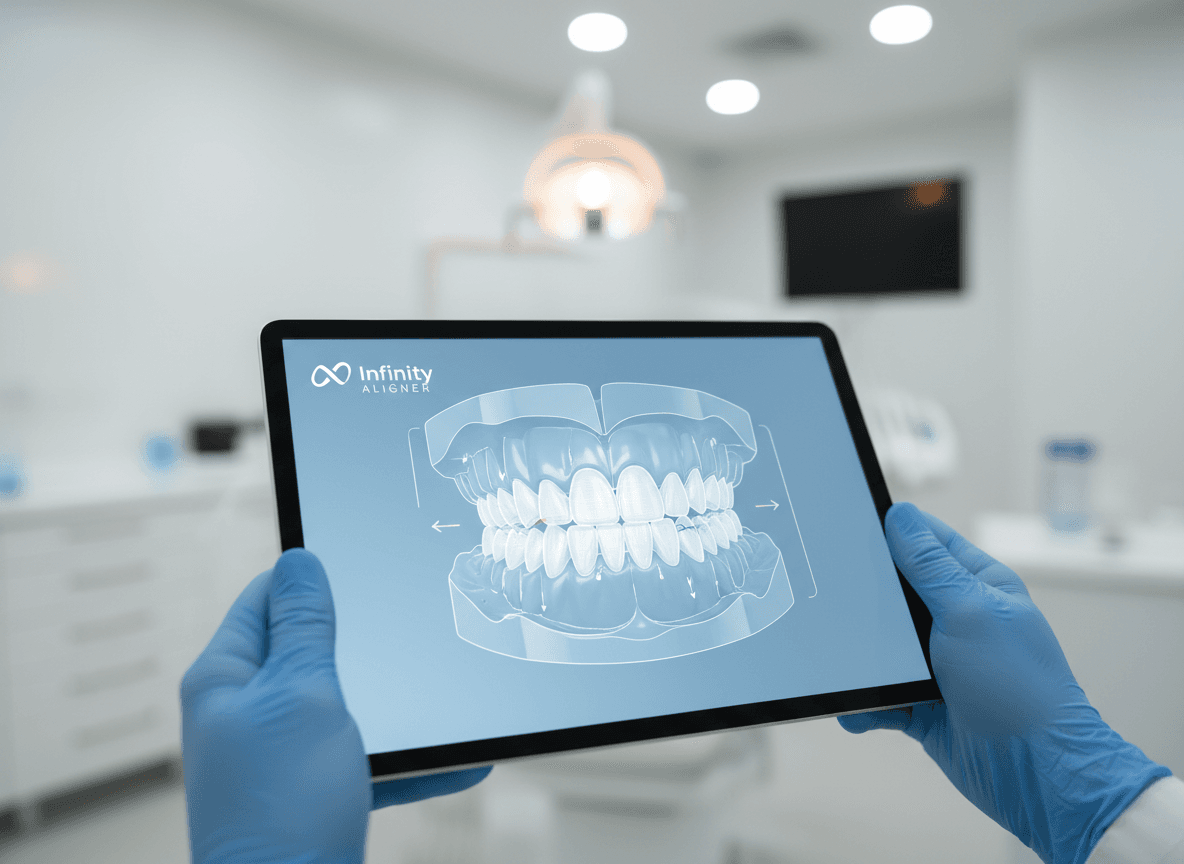
Pre-prosthetic planning requires a shared case analysis between the orthodontist and the restorative practitioner. The digital diagnostic setup — produced from an intraoral scan or CBCT model — is the cornerstone of this collaboration. It allows simulation of the final prosthetic outcome (virtual or physical wax-up) and retroactively defines the orthodontic movements needed to achieve it. Any aligner prescription in this context must therefore be grounded in a finalised prosthetic vision, not simply convenience-driven aesthetic alignment.
Pre-Implant Orthodontics: The Four Biomechanical Objectives
- Creating or recovering mesiodistal space: insufficient implant space compromises implant diameter selection and peri-implant gingival seal quality. The minimum clinical rule is 7 mm between the axial surfaces of adjacent teeth for a standard implant (Ø 3.5–4.1 mm). Below 6 mm, the risk of root contact resorption is significant.
- Root parallelism: the roots of teeth flanking the edentulous space must be parallel to each other and to the planned implant insertion axis. A parallelism defect > 5° forces the surgeon to deviate the implant axis, degrading the prosthetic emergence profile and potentially threatening adjacent structures. Periapical or CBCT radiographic control at the end of orthodontic treatment is mandatory.
- Forced orthodontic extrusion (coronoapical traction): when a tooth destined for extraction has a deficient alveolar bone level (residual periodontal pocket, subcrestal fracture, external resorption), controlled orthodontic extrusion migrates the alveolar bone and attached gingiva coronally with the tooth, creating additional bone and mucosal volume before implantation. The optimal extrusion rate is 1 mm per week to allow concomitant bone remodelling without rupture of the alveolodental bundle.
- Pre-prosthetic orthodontic intrusion: when an opposing tooth has supraerupted into an edentulous zone (Thielemann phenomenon), the prosthetic occlusal space is reduced or absent. Orthodontic intrusion — one of the most mechanically difficult movements to produce — restores the vertical space required for the implant-supported crown or bridge height.
Forced Extrusion: Detailed Clinical Protocol
Orthodontic pre-implant extrusion is a tissue engineering technique in its own right. It relies on the application of a light continuous force (50–80 g) oriented along the long axis of the tooth, over 4 to 12 weeks depending on the volume of gain sought. Retention via supracrestal fibre fibrotomy is performed once 1 to 2 mm of gain is achieved, to prevent relapse and stabilise the tissues. Tooth extraction is delayed 2 to 4 weeks after extrusion completion to allow maturation of the newly formed bone clot.
- Primary indication: vertical or horizontal subcrestal fracture, external cervical resorption, localised residual periodontal pocket with angular bone loss.
- Contraindications: generalised horizontal bone loss, ankylosis (absent functional periodontal ligament), unfavourable crown-to-root ratio after extrusion.
- Pre- and post-extrusion CBCT control: measurement of crestal height gain and vestibular thickness at the extraction-implantation site.
- Role of aligners: thermoformed trays deliver extrusion force continuously with excellent root torque control, avoiding unwanted tipping. A rectangular vertical composite attachment is placed cervically on the tooth to be extruded to optimise force transmission.
Mesiodistal Space Management: Opening vs. Closing
The choice between space opening (for an implant or bridge) and space closure (to avoid prosthesis) is a major interdisciplinary decision. It depends on several converging factors:
- Adjacent tooth size and Bolton ratio: a mandibular Bolton excess may favour space closure over implantation, particularly in premolar agenesis cases.
- Residual bone volume and site anatomy: an implant site with less than 5 mm of vestibulopalatal thickness requires prior bone grafting, which may tip the balance towards orthodontic closure if clinically viable.
- Orthodontic anchorage: space opening adjacent to unilateral edentulous sites requires reinforced anchorage (temporary miniscrews, skeletal anchorage). Aligners with attachments provide excellent molar anchorage control in these situations.
- Comparative treatment duration: complete orthodontic space closure may take 12 to 18 months; space opening for a single-unit implant can be achieved in 4 to 8 weeks if the residual gap is 5 to 6 mm.
- Aesthetic outcome: anterior space closure alters dentolabial width ratios and the incisal relationship, requiring a carefully simulated aesthetic project.
Pre-Veneer Orthodontics: Alignment, Torque and Proclination Reduction
Placement of pressed or feldspathic ceramic veneers demands impeccable enamel thickness conditions. Any preparation on a malpositioned tooth — in labioversion, rotation or crossbite — forces the practitioner to sacrifice more enamel to achieve a correct emergence axis. Pre-veneer orthodontics restores the optimal dental axis before any preparation, reducing the depth of vestibular grinding to 0.3–0.5 mm and preserving the amelodentinal junction.
- Incisor proclination reduction: a maxillary incisor in excessive labioversion (overjet > 4 mm) requires a thick veneer to mask shade and rotation. Prior orthodontic retraction reduces the ceramic thickness needed, improving translucency and natural appearance.
- Rotation correction: a 15° rotation on a central incisor creates a preparation asymmetry that compromises the cervical finish line. Orthodontic correction eliminates this disparity and homogenises preparation zones.
- Residual diastema management: when an interincisor diastema is to be closed with veneers, orthodontics can redistribute space equitably between the teeth involved, avoiding an abnormally wide veneer on a single element — which impairs dental proportions and the gingival zenith.
- Gingival levels and cervical margins: irregular dental cervical margins on a misaligned arch create disharmonious cervical lines under veneers. Alignment orthodontics, supplemented if necessary with finishing gingivoplasty, homogenises visible crown heights.
- Post-orthodontic waiting period before preparation: after aligner removal and before veneer preparation, a minimum 3 to 6-month period is recommended to allow reorganisation of supracrestal periodontal fibres and reduce the risk of positional relapse under the prosthesis.
The Specific Role of Clear Aligners in Pre-Prosthetic Orthodontics
Thermoformed aligners offer several decisive advantages in the pre-prosthetic context over conventional fixed orthodontics:
- Precise root torque control: through rectangular composite attachments, aligners allow fine-tuned control of root axes adjacent to the implant space — difficult to achieve with standard brackets without specific prescription.
- No brackets on prosthetic abutment teeth: in fixed orthodontics, brackets on teeth destined for preparation can create enamel lesions during debonding. Aligners avoid all abrasive contact on future preparation surfaces.
- Removability for intercurrent surgical procedures: extraction of the tooth to be replaced, implant placement and any bone grafts can be performed without dismantling a fixed retention appliance.
- 3D movement simulation: the digital aligner setup is itself a prosthetic communication tool. It can be shared with the dental technician to integrate the planned orthodontic movement into the wax-up design or surgical implant guide.
- Integrated retention at end of treatment: the final maintenance tray can serve as provisional retention during the pre-prosthetic waiting period, without requiring a bonded retainer that would complicate cervical access for peri-implant care.
Temporal Coordination with the Implant Surgeon
The optimal therapeutic sequence in a pre-orthodontic implant case follows a rigorous multi-phase protocol:
| Phase | Procedure | Indicative Timeframe |
|---|---|---|
| 1 | Diagnostic CBCT + interdisciplinary digital setup | Day 0 |
| 2 | Pre-implant orthodontics (parallelism, space, extrusion) | 4 to 16 weeks |
| 3 | Radiographic review + site validation by surgeon | End of phase 2 |
| 4 | Extraction (if not already done) + implantation + grafting if needed | After validation |
| 5 | Bone and mucosal healing + active orthodontic retention | 3 to 6 months |
| 6 | Prosthetic loading (implant-supported crown) | After confirmed osseointegration |
| 7 | Retention removal + fixed lingual stabilisation retainer | Concurrent with prosthesis |
Key Clinical Watchpoints
- Never begin pre-implant orthodontics without a complete periodontal assessment: any residual inflammatory focus contraindicates orthodontic movements and compromises subsequent peri-implant healing.
- Systematic CBCT at end of orthodontic treatment: three-dimensional radiographic verification of root relationships and crestal bone volume determines implant feasibility without additional grafting.
- Inform the patient of the overall timeline: an orthodontics + implant + prosthesis treatment plan typically spans 12 to 24 months. Clear communication about this schedule improves therapeutic compliance.
- Document every step: standardised intraoral photographs, control impressions and shared written records between all treating practitioners constitute the minimum documentation required in these multidisciplinary cases.
- Anticipate post-orthodontic retention: relapse risk is particularly high in forced extrusion and space management cases. Retention must be planned before the end of active treatment.
Conclusion
Pre-prosthetic orthodontics represents one of the most demanding and rewarding applications of contemporary orthodontics. It requires from the practitioner rigorous biomechanical mastery, an anticipatory prosthetic vision and seamless coordination across specialties. Clear aligners, thanks to their prescription precision, removability and native integration into interdisciplinary digital workflows, have established themselves as the tool of choice for the vast majority of these treatments. A perfectly prepared implant site, parallel root axes and quality soft tissue are not bonuses — they are the minimum conditions for a durable prosthetic outcome.
Infinity Aligner
Clinical & editorial team
More articles
How to Choose Clear Aligners in Tunisia
Clear Aligners vs Braces: Complete Comparison
How Much Do Clear Aligners Cost in Tunisia?
How Long Does Clear Aligner Treatment Take?
How to Clean and Care for Your Clear Aligners Daily
Clear Aligners for Teenagers: What Parents Need to Know
Gap Teeth & Diastema: Can Clear Aligners Fix Them?
Can You Play Sports with Clear Aligners?
3D Smile Simulation: How It Works and What to Expect
Orthodontic Relapse: Why Teeth Move After Treatment
Intraoral Scanner vs Traditional Impressions: What's the Difference?
Clear Aligners for Adults: Is It Ever Too Late?
Wisdom Teeth and Clear Aligners: Are They Compatible?
Clear Aligners: A Versatile Therapeutic Approach in Orthodontics
Orthodontics and Periodontal Health: What Every Patient Needs to Know
The Technology Behind Clear Aligners: From Design to Tray
How to Prepare for Your Orthodontic Consultation: 10 Questions to Ask
Bruxism and Clear Aligners: Can You Correct and Protect at the Same Time?
Class II Malocclusion and Clear Aligners: What Treatment Options Exist?
Clear Aligners and Dental Implants: Protocol, Timing and Clinical Cases
Digital Workflow and Aligner Biomechanics: The Advanced Practitioner Protocol
The Limits of Clear Aligners: Identifying Complex Cases Beyond Their Reach
Aligner Manufacturing: Thermoforming, 3D Printing and Polymer Science
Invisible Orthodontics in 2030: Predictive AI, Direct Printing and Active Materials
Smile Without Borders: The Price of Aligners Between Tunisia, Europe and Canada
Attachments in Invisible Orthodontics: The Silent Levers of Biomechanics

The Smile Beyond the Mirror: The Profound Impact of Dental Alignment on Psychological Well-being
Tunisia: The New Eldorado of Digital Dentistry and Medical Tourism
Post-Orthodontic Retention: The Forgotten Step That Decides Everything
What You Can (and Cannot) Eat With Clear Aligners
Teeth Whitening and Clear Aligners: Can You Treat and Whiten at the Same Time?
TMJ and Clear Aligners: How Invisible Orthodontics Acts on Jaw Pain
The Different Types of Dental Retainer: A Complete Guide After Orthodontic Treatment
The hidden dangers of metal braces: what patients need to know
Root resorption: the silent risk of poorly managed orthodontic treatments
Orthodontics and cavities: how metal braces compromise dental hygiene
Orthodontic relapse: why teeth return to their original position
Braces and chronic pain: the underestimated impact on daily quality of life
Intraoral scanner vs conventional impressions: dimensional analysis and clinical implications
CAD/CAM digital workflow in orthodontics: from intraoral scanning to aligner fabrication
Deformation, shrinkage and cumulative errors: why the conventional impression chain compromises aligner precision
Intraoral Scanners 2025: Complete Technical and Metrological Comparison
Why Choose Infinity Aligner? The Complete Guide for Dental Practitioners
Composite Selection for Aligner Attachments: Mechanical Analysis and Clinical Protocol
TMJ and Malocclusion: Differential Diagnosis and Clinical Approach for the Practitioner
Travelling with Clear Aligners: The Complete Guide for Stress-Free Trips
The First Month with Aligners: What to Expect Week by Week
Consult a certified dentist
Our 200+ certified partners in Tunis, Sfax, Sousse and the francophone zone welcome you.
Book a consultation