Deformation, shrinkage and cumulative errors: why the conventional impression chain compromises aligner precision
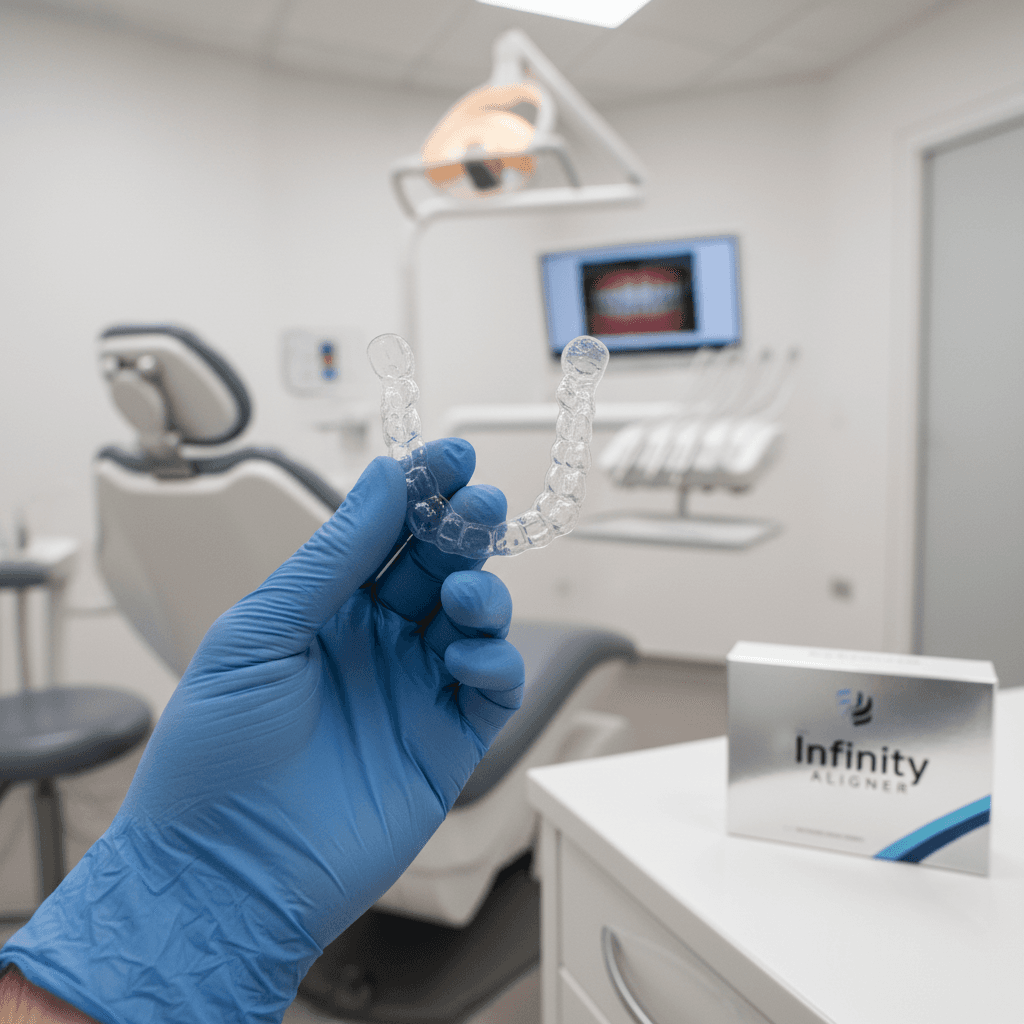
Polymerisation shrinkage, plaster expansion, pouring and storage errors: comprehensive physicochemical analysis of dimensional error sources in the conventional impression chain.
The conventional impression chain — from intraoral taking to model delivery at the laboratory — involves a succession of physicochemical transformations, each introducing its own dimensional error. These errors, individually acceptable in certain prosthetic contexts, become clinically significant in the demanding context of orthodontic aligner fabrication. This article analyses each error source with its quantitative data and underlying mechanisms.
1. Physical chemistry of impression materials: deformation mechanisms
Understanding deformations requires descending to the molecular mechanism level. The two major families of elastomeric impression materials (A-silicone and polyether) exhibit distinct deformation mechanisms:
- Polyvinylsiloxane (A-silicone): the addition reaction between vinyl groups and silicon hydrides, catalysed by chloroplatinic acid, generates no volatile by-products. Volumetric shrinkage is therefore minimal (0.05–0.15%) and essentially thermal. Elastic deformation on removal is 0.2–0.4%, recovered to over 99% in 30 seconds if the material is correctly polymerised.
- Polyether: cationic polymerisation generates significant internal stresses. The material is intrinsically hydrophilic, giving it good wettability but leading to water absorption of up to 0.5% by weight after 24 h exposure to ambient humidity, inducing progressive dimensional expansion.
- Alginate (irreversible hydrocolloid): gelation of alginate salt with calcium sulphate releases bound water that evaporates after setting. Synaeresis (contraction by water expulsion) can reach 3 to 5% by volume if the impression is exposed to dry air, while imbibition (expansion by water absorption) can reach 2 to 4% in a humid environment. These two opposing processes make alginate dimensional stability fundamentally unpredictable.
2. Deformation on removal: an inevitable error
Removing the impression from the oral cavity imposes temporary mechanical deformation in undercut areas (areas where anatomical geometry creates mechanical blocking during extraction). For VPS — the most widely used material in precision impressions — deformation on removal follows the Kelvin-Voigt viscoelastic behaviour law: instantaneous elastic deformation (recovered immediately) and deferred viscoelastic deformation (recovered in 10 to 60 minutes depending on the material's Shore hardness).
In clinical practice, pouring must be delayed by at least 30 minutes after removal to allow viscoelastic recovery to complete. This temporal constraint is often ignored in practice, generating models systematically deformed in undercut areas — precisely the cervical and interproximal areas most important for aligner fit.
3. Plaster thermal expansion: a systematic bias
Type IV or V dental stone used for model pouring undergoes setting expansion during the rehydration reaction of calcium sulphate hemihydrate. Depending on formulation and water/plaster ratio:
| Stone type | Setting expansion | Vickers hardness | Demoulding time |
|---|---|---|---|
| Type II (plaster of Paris) | 0.6–1.0% | 30–50 HV | 45–60 min |
| Type III (hard plaster) | 0.2–0.5% | 80–120 HV | 30–45 min |
| Type IV (extra-hard stone) | 0.1–0.2% | 120–180 HV | 30–45 min |
| Type V (high-expansion stone) | 0.1–0.3% (controlled) | 120–180 HV | 30–45 min |
| Epoxy resin (alternative) | < 0.02% | 200–250 HV | 12–24 h |
For a 120 mm arch, a setting expansion of 0.2% (type IV, best conditions) translates to an absolute error of 0.24 mm = 240 µm. This error is systematic and proportionally affects all dimensions of the model. It adds, not algebraically but vectorially, to all other error sources in the chain.
4. Air bubbles: point defects with high clinical impact
Air bubbles trapped during stone pouring create artefact tubercles on the model — small surface elevations where a bubble was present in the impression. These tubercles, even 0.1 to 0.3 mm in height, create parasitic contact points on the thermoformed aligner that modify force distribution in an unplanned way. Prevention involves pouring under a vibrator and using a wetting agent (surfactant) on the impression before pouring.
5. Transport and storage errors
The logistics chain between practice and laboratory introduces additional documented but rarely quantified error sources:
- Thermal variations in transit: VPS impressions stored in vehicles or postal packages can undergo thermal cycles of ±30°C. The thermal expansion coefficient of VPS is 200–300 µm/m/°C — on a 120 mm arch, a 20°C variation produces a dimensional error of 48–72 µm.
- Mechanical deformation of impression under its own weight: complete impressions, if not correctly positioned in their container, can undergo deformation by sagging of unsupported areas.
- Handling errors during model demoulding: microcracks in the plaster model, visually imperceptible, create missing or erroneous data areas during laboratory scanning.
- Cross-contamination and chemical disinfection: disinfectant solutions (1% hypochlorite, glutaraldehyde, ortho-phthalaldehyde) can cause micro-surface expansions in alginate (+ 0.5% in 10 min in 1% hypochlorite) and slight surface deformation in polyethers.
6. Cumulative error analysis: the uncertainty propagation rule
When independent errors combine in a measurement chain, their combined uncertainty is expressed according to the uncertainty propagation rule (JCGM 100:2008 — Guide to the Expression of Uncertainty in Measurement). For independent, uncorrelated errors, the combined uncertainty is the square root of the sum of squares of individual uncertainties. For the alginate-type IV plaster chain under non-optimal conditions:
| Error source | Estimated error (µm RMS) | Correlation with other sources |
|---|---|---|
| Alginate shrinkage/expansion (20 min delay) | 180–350 µm | None |
| Type IV plaster expansion | 120–240 µm | None |
| Deformation on removal | 50–120 µm | Partial (undercut areas) |
| Air bubbles (1–3 bubbles/arch) | 30–80 µm (local) | None |
| Laboratory scan error | 25–60 µm | None |
| Estimated total (root sum of squares) | 230–450 µm | — |
For comparison, the VPS chain (type IV, optimal protocol, pouring delay > 30 min) presents an estimated cumulative error of 80–150 µm. And the intraoral scan chain (confocal microscopy, optimised protocol) stands at 20–45 µm. The gap between the alginate chain and the intraoral scanner represents a factor of 5 to 10 in terms of dimensional error.
7. Clinical relevance threshold: when error becomes a problem
To contextualise these errors, it is useful to compare them with the functional parameters of aligners:
- Standard aligner thickness: 700 to 900 µm. A 200 µm error represents 22 to 28% of total thickness — sufficient to significantly modify contact stresses.
- Amplitude of an elementary movement per stage: 100 to 250 µm. A 200 µm error represents 80 to 200% of a movement — meaning an entire stage can be "absorbed" by the model's dimensional error.
- Standard rectangular attachment height: 1.5 to 2.0 mm. A 200 µm error represents 10 to 13% of attachment height — significant modification of the transmitted force vector.
- Average inter-bracket space (if coexisting with braces): 0.5 to 3.0 mm. Errors > 100 µm in these spaces directly compromise correct expression of the mechanics.
Conclusion
The conventional impression chain accumulates inevitable physicochemical error sources that, under real clinical conditions (pouring delays, storage conditions, stone quality), result in models whose fidelity is insufficient for optimal precision aligner fabrication. The transition to a complete digital chain — direct intraoral scan, STL data transmission, fabrication on validated printed model — is not merely a technological modernisation but a clinical necessity to guarantee the predictability of aligner orthodontic treatments.
Infinity Aligner
Clinical & editorial team
More articles

How to Choose Clear Aligners in Tunisia

Clear Aligners vs Braces: Complete Comparison

How Much Do Clear Aligners Cost in Tunisia?

How Long Does Clear Aligner Treatment Take?

How to Clean and Care for Your Clear Aligners Daily

Clear Aligners for Teenagers: What Parents Need to Know
Gap Teeth & Diastema: Can Clear Aligners Fix Them?
Can You Play Sports with Clear Aligners?

3D Smile Simulation: How It Works and What to Expect
Orthodontic Relapse: Why Teeth Move After Treatment

Intraoral Scanner vs Traditional Impressions: What's the Difference?

Clear Aligners for Adults: Is It Ever Too Late?
Wisdom Teeth and Clear Aligners: Are They Compatible?

Clear Aligners: A Versatile Therapeutic Approach in Orthodontics

Orthodontics and Periodontal Health: What Every Patient Needs to Know
The Technology Behind Clear Aligners: From Design to Tray

How to Prepare for Your Orthodontic Consultation: 10 Questions to Ask

Bruxism and Clear Aligners: Can You Correct and Protect at the Same Time?

Class II Malocclusion and Clear Aligners: What Treatment Options Exist?

Clear Aligners and Dental Implants: Protocol, Timing and Clinical Cases

Digital Workflow and Aligner Biomechanics: The Advanced Practitioner Protocol

The Limits of Clear Aligners: Identifying Complex Cases Beyond Their Reach
Aligner Manufacturing: Thermoforming, 3D Printing and Polymer Science
Invisible Orthodontics in 2030: Predictive AI, Direct Printing and Active Materials
Smile Without Borders: The Price of Aligners Between Tunisia, Europe and Canada
Attachments in Invisible Orthodontics: The Silent Levers of Biomechanics

The Smile Beyond the Mirror: The Profound Impact of Dental Alignment on Psychological Well-being
Tunisia: The New Eldorado of Digital Dentistry and Medical Tourism
Post-Orthodontic Retention: The Forgotten Step That Decides Everything
What You Can (and Cannot) Eat With Clear Aligners
Teeth Whitening and Clear Aligners: Can You Treat and Whiten at the Same Time?
TMJ and Clear Aligners: How Invisible Orthodontics Acts on Jaw Pain
The Different Types of Dental Retainer: A Complete Guide After Orthodontic Treatment
The hidden dangers of metal braces: what patients need to know
Root resorption: the silent risk of poorly managed orthodontic treatments

Orthodontics and cavities: how metal braces compromise dental hygiene

Orthodontic relapse: why teeth return to their original position

Braces and chronic pain: the underestimated impact on daily quality of life
Intraoral scanner vs conventional impressions: dimensional analysis and clinical implications
CAD/CAM digital workflow in orthodontics: from intraoral scanning to aligner fabrication
Intraoral Scanners 2025: Complete Technical and Metrological Comparison
Why Choose Infinity Aligner? The Complete Guide for Dental Practitioners
Composite Selection for Aligner Attachments: Mechanical Analysis and Clinical Protocol
TMJ and Malocclusion: Differential Diagnosis and Clinical Approach for the Practitioner
Travelling with Clear Aligners: The Complete Guide for Stress-Free Trips

The First Month with Aligners: What to Expect Week by Week
Pre-Prosthetic Orthodontics: Preparing the Site Before Implants or Veneers
Consult a certified dentist
Our 200+ certified partners in Tunis, Sfax, Sousse and the francophone zone welcome you.
Book a consultation