Intraoral scanner vs conventional impressions: dimensional analysis and clinical implications
Trueness, precision, material deformation, ISO 12836 standards: a rigorous comparative analysis of optical and physical impression technologies for clear aligner fabrication.
The quality of a clear aligner depends first and foremost on the fidelity of the anatomical reproduction on which it will be thermoformed or printed. For decades, this reproduction was based on physical elastomeric impressions. The advent of intraoral scanners (IOS) has profoundly disrupted this paradigm. This article provides a rigorous technical analysis of the fundamental differences between these two impression modalities, intended for specialist orthodontists and dental surgeons.
1. Terminology and normative definitions (ISO 12836)
Before any comparison, it is essential to distinguish two distinct metric parameters that the ISO 12836:2015 standard — relating to the digitisation of dental models — defines precisely:
- Trueness: mean deviation between the measured value and the true reference value. Expressed in micrometres (µm), it quantifies the systematic bias of the system.
- Precision: degree of agreement between repeated measurements under the same conditions. It accounts for the random variability of the system.
- Accuracy: combination of both preceding parameters. A system can be precise (reproducible) without being accurate (biased) — and vice versa.
- The clinically acceptable threshold in aligner orthodontics is generally set at ≤ 100 µm trueness and ≤ 50 µm precision for critical areas (occlusal contacts, attachment zones).
2. Intraoral scanning technologies: physical principles
Current intraoral scanners are based on three major families of optical principles, each with its own metric characteristics:
| Technology | Principle | Lateral resolution | Example systems |
|---|---|---|---|
| Structured light (fringe projection) | Projection of sinusoidal fringes onto the surface; deformation decoded by triangulation | 20–50 µm | iTero Element 5D, 3Shape TRIOS 5 |
| Confocal microscopy | Point illumination; only in-focus light detected (pinhole); point-by-point scanning | < 10 µm | CEREC Primescan, Carestream CS 3800 |
| Active Wavefront Sampling (AWS) | Analysis of light wavefront deformation; depth calculation by signal processing | 20–35 µm | TRIOS 3/4 (alternative mode) |
| Time-of-flight / Photogrammetry | Laser light travel time measurement; 3D reconstruction from point cloud | 50–100 µm | Primarily laboratory systems |
Confocal microscopy offers the highest lateral resolution and the best performance in undercut areas (deep interproximal spaces, gingival sulcus). Structured light has the advantage of faster acquisition (important for uncooperative patients) but can generate artefacts in the presence of highly reflective or translucent surfaces (hypomineralised enamel, polished ceramic restorations).
3. Conventional impression materials: properties and intrinsic limitations
Physical impression materials used in orthodontics belong to two major families, with very different rheological and dimensional characteristics:
| Material | Chemistry | Polymerisation shrinkage | Dimensional stability | Viscosity |
|---|---|---|---|---|
| Alginate (irreversible hydrocolloid) | Alginic acid salt + calcium sulphate | Initial expansion 0.2–0.5% then hygroscopic contraction | Poor: pouring required < 15 min | Low to medium |
| Polyvinylsiloxane (A-silicone / VPS) | Addition polysiloxanes with chloroplatinic acid catalyst | 0.05–0.15% (contraction) | Excellent: stable up to 7 days | Very low to extra-high |
| Polyether (PE) | Cationic polymerisation by ionic activation | 0.10–0.20% (contraction) | Good to 72 h; hygroscopic beyond | Medium to high |
| Polyvinylsiloxane-ether hybrid (PVSE) | A-silicone + polyether copolymer | 0.08–0.12% | Very good (7 days) | Low to medium |
Alginate — still widely used in orthodontics for its convenience and cost — exhibits hygroscopic contraction post-setting that can reach 1.5 to 2.5% if pouring is delayed by more than 30 minutes. In the context of aligner fabrication, this deformation is unacceptable: a 2% error on a 120 mm arch translates to a 2.4 mm discordance — equivalent to 4 to 6 trays of erroneous tooth movement.
4. Comparative precision data: what published literature measures
Several prospective studies of high methodological quality have compared the dimensional precision of IOS with physical impressions using calibrated reference arches or cone beam computed tomography (CBCT) as a gold standard. Results converge toward the following magnitudes:
| Impression method | Mean trueness (µm) | Precision (µm) | Most problematic critical area |
|---|---|---|---|
| Intraoral scanner (confocal microscopy) | 18–35 µm | 8–20 µm | Deep undercut areas |
| Intraoral scanner (structured light) | 30–65 µm | 15–35 µm | Reflective, translucent surfaces |
| VPS impression + plaster model + lab scan | 45–85 µm | 25–45 µm | Impression-model interface |
| VPS impression + direct impression scan | 55–95 µm | 30–55 µm | Undercut areas (optical inversion) |
| Alginate impression + plaster model | 120–350 µm | 80–160 µm | Entire surface (hygroscopic deformation) |
These data show that the best intraoral scanner is between 3 and 10 times more precise than the alginate-plaster chain, and between 1.5 and 2.5 times more precise than the VPS-plaster chain under best conditions. These differences have direct repercussions on aligner fit, attachment expression and the predictability of planned movements.
5. Error sources specific to each method
Analysis of error sources highlights the fundamentally different nature of the two chains:
- Conventional impressions — systemic errors: dimensional shrinkage of material during polymerisation, thermal expansion of plaster during setting (0.1 to 0.4%), distortion during impression removal, air bubbles trapped in the model, model wear during repeated handling, laboratory scan errors on the physical model.
- Conventional impressions — human errors: uncontrolled mixing time and powder/water ratio (alginate), delay between impression and pouring (alginate), inappropriate storage temperature (hygroscopic PE), poor undercut management during removal.
- Intraoral scanner — systemic errors: accumulation of stitching errors (segment assembly) on long arches, surface artefacts on reflective materials, dead zones in tight interproximal spaces or deep sulcus, patient movement during acquisition.
- Intraoral scanner — human errors: non-optimised scanning protocol (sequence, speed, insufficient overlaps), uncontrolled saliva and moisture, uncalibrated processing software.
6. Clinical implications for clear aligner fabrication
Dimensional impression precision directly impacts three critical aligner parameters:
- Gingival fit (cervical adaptation): a 50 µm error on the gingival profile creates a gap or excessive pressure that compromises the transmission of planned forces. Cervical fit is the first parameter to degrade with imprecise impressions.
- Attachment expression: attachments (thermoformed bumps in the plastic) transmit torques and forces according to a precise geometry. A 100 µm positional error on a rectangular attachment modifies its force vector in a clinically significant way.
- Occlusal precision: occlusal contacts programmed in the 3D simulation must correspond to real geometries. On models derived from alginate, distortions are sufficient to create unplanned occlusal interferences that disrupt aligner wear.
7. Special cases and limitations of intraoral scanners
Despite their undeniable metric advantages, intraoral scanners have clinical limitations that the practitioner must be aware of:
- Extended edentulous areas (> 3 consecutive teeth): the spatial reference between arch segments becomes insufficient; stitching errors accumulate and can reach 100–200 µm over edentulous ridges.
- Non-precious metal or amalgam restorations: specular reflection from metallic surfaces saturates the optical sensor and creates areas of missing data. A titanium dioxide spray opacifier can be used (with the cleaning implications this entails).
- Patients with limited mouth opening or pronounced gag reflex: probe ergonomics limits access to mandibular second molars. Physical impressions with an adapted tray may remain preferable in these cases.
- Integration with CBCT data: superimposition (registration) of the intraoral scan onto the CBCT is essential for planning root movements. The quality of this superimposition depends directly on the fidelity of the surface scan.
Conclusion
Published metric data unambiguously establishes the dimensional superiority of latest-generation intraoral scanners over physical impressions for the fabrication of clear aligners. The digital chain eliminates or drastically reduces the systemic error sources of the conventional chain, offers complete traceability and direct integration into 3D orthodontic planning software. For any practitioner wishing to optimise the precision of their aligner treatments, investment in a quality intraoral scanner is today clinically justified by the available data.
Infinity Aligner
Clinical & editorial team
More articles
How to Choose Clear Aligners in Tunisia
Clear Aligners vs Braces: Complete Comparison
How Much Do Clear Aligners Cost in Tunisia?
How Long Does Clear Aligner Treatment Take?
How to Clean and Care for Your Clear Aligners Daily
Clear Aligners for Teenagers: What Parents Need to Know
Gap Teeth & Diastema: Can Clear Aligners Fix Them?
Can You Play Sports with Clear Aligners?
3D Smile Simulation: How It Works and What to Expect
Orthodontic Relapse: Why Teeth Move After Treatment
Intraoral Scanner vs Traditional Impressions: What's the Difference?
Clear Aligners for Adults: Is It Ever Too Late?
Wisdom Teeth and Clear Aligners: Are They Compatible?

Clear Aligners: A Versatile Therapeutic Approach in Orthodontics
Orthodontics and Periodontal Health: What Every Patient Needs to Know
The Technology Behind Clear Aligners: From Design to Tray
How to Prepare for Your Orthodontic Consultation: 10 Questions to Ask
Bruxism and Clear Aligners: Can You Correct and Protect at the Same Time?
Class II Malocclusion and Clear Aligners: What Treatment Options Exist?
Clear Aligners and Dental Implants: Protocol, Timing and Clinical Cases
Digital Workflow and Aligner Biomechanics: The Advanced Practitioner Protocol
The Limits of Clear Aligners: Identifying Complex Cases Beyond Their Reach
Aligner Manufacturing: Thermoforming, 3D Printing and Polymer Science
Invisible Orthodontics in 2030: Predictive AI, Direct Printing and Active Materials
Smile Without Borders: The Price of Aligners Between Tunisia, Europe and Canada
Attachments in Invisible Orthodontics: The Silent Levers of Biomechanics

The Smile Beyond the Mirror: The Profound Impact of Dental Alignment on Psychological Well-being
Tunisia: The New Eldorado of Digital Dentistry and Medical Tourism
Post-Orthodontic Retention: The Forgotten Step That Decides Everything
What You Can (and Cannot) Eat With Clear Aligners
Teeth Whitening and Clear Aligners: Can You Treat and Whiten at the Same Time?
TMJ and Clear Aligners: How Invisible Orthodontics Acts on Jaw Pain
The Different Types of Dental Retainer: A Complete Guide After Orthodontic Treatment
The hidden dangers of metal braces: what patients need to know
Root resorption: the silent risk of poorly managed orthodontic treatments

Orthodontics and cavities: how metal braces compromise dental hygiene
Orthodontic relapse: why teeth return to their original position
Braces and chronic pain: the underestimated impact on daily quality of life
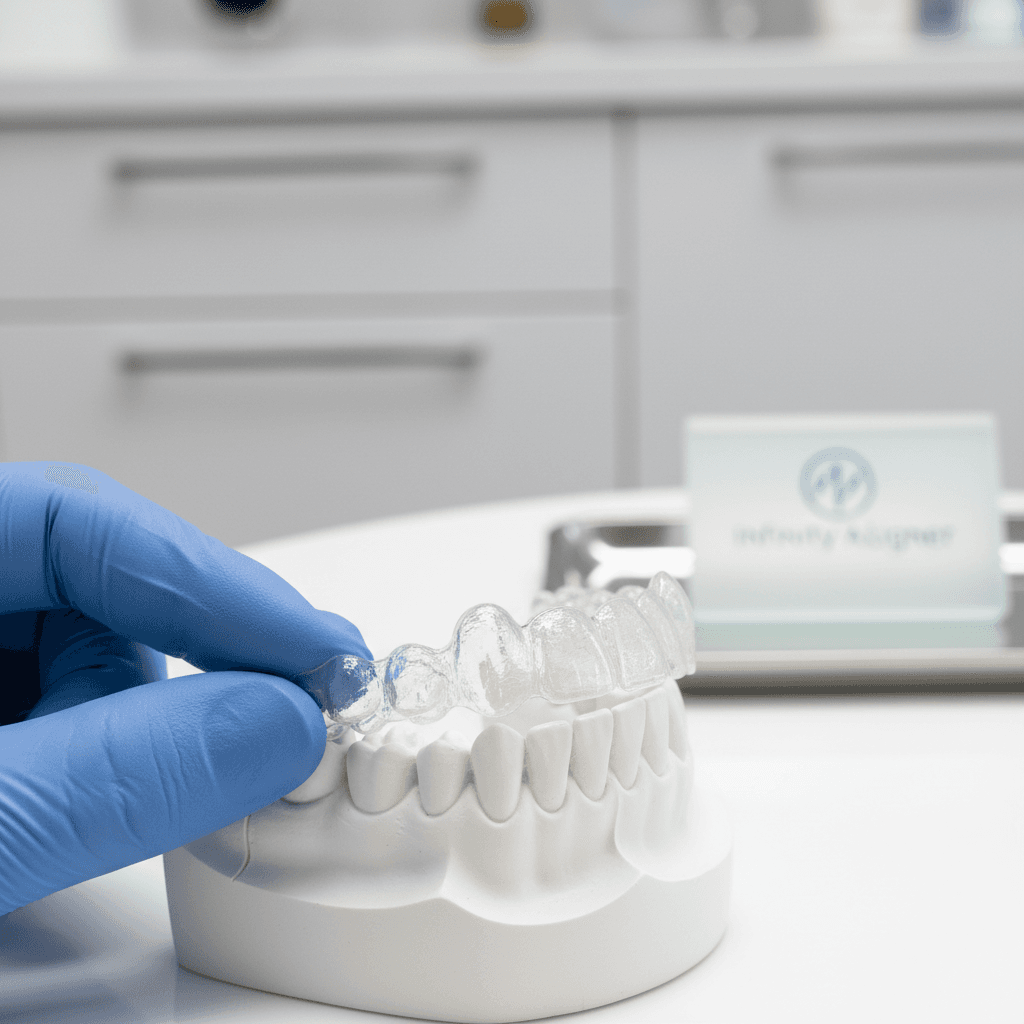
CAD/CAM digital workflow in orthodontics: from intraoral scanning to aligner fabrication
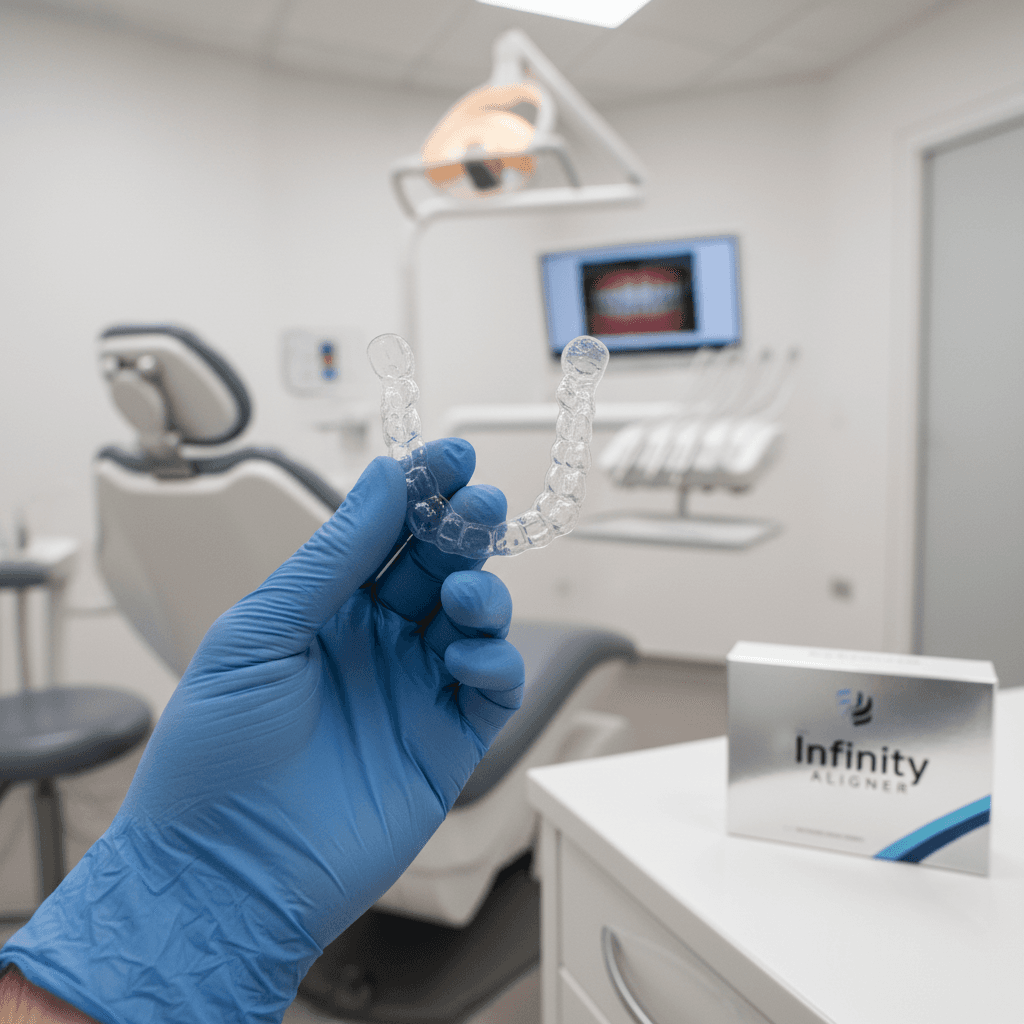
Deformation, shrinkage and cumulative errors: why the conventional impression chain compromises aligner precision
Intraoral Scanners 2025: Complete Technical and Metrological Comparison
Why Choose Infinity Aligner? The Complete Guide for Dental Practitioners
Composite Selection for Aligner Attachments: Mechanical Analysis and Clinical Protocol
TMJ and Malocclusion: Differential Diagnosis and Clinical Approach for the Practitioner
Travelling with Clear Aligners: The Complete Guide for Stress-Free Trips
The First Month with Aligners: What to Expect Week by Week
Pre-Prosthetic Orthodontics: Preparing the Site Before Implants or Veneers
Consult a certified dentist
Our 200+ certified partners in Tunis, Sfax, Sousse and the francophone zone welcome you.
Book a consultation