Attachments in Invisible Orthodontics: The Silent Levers of Biomechanics
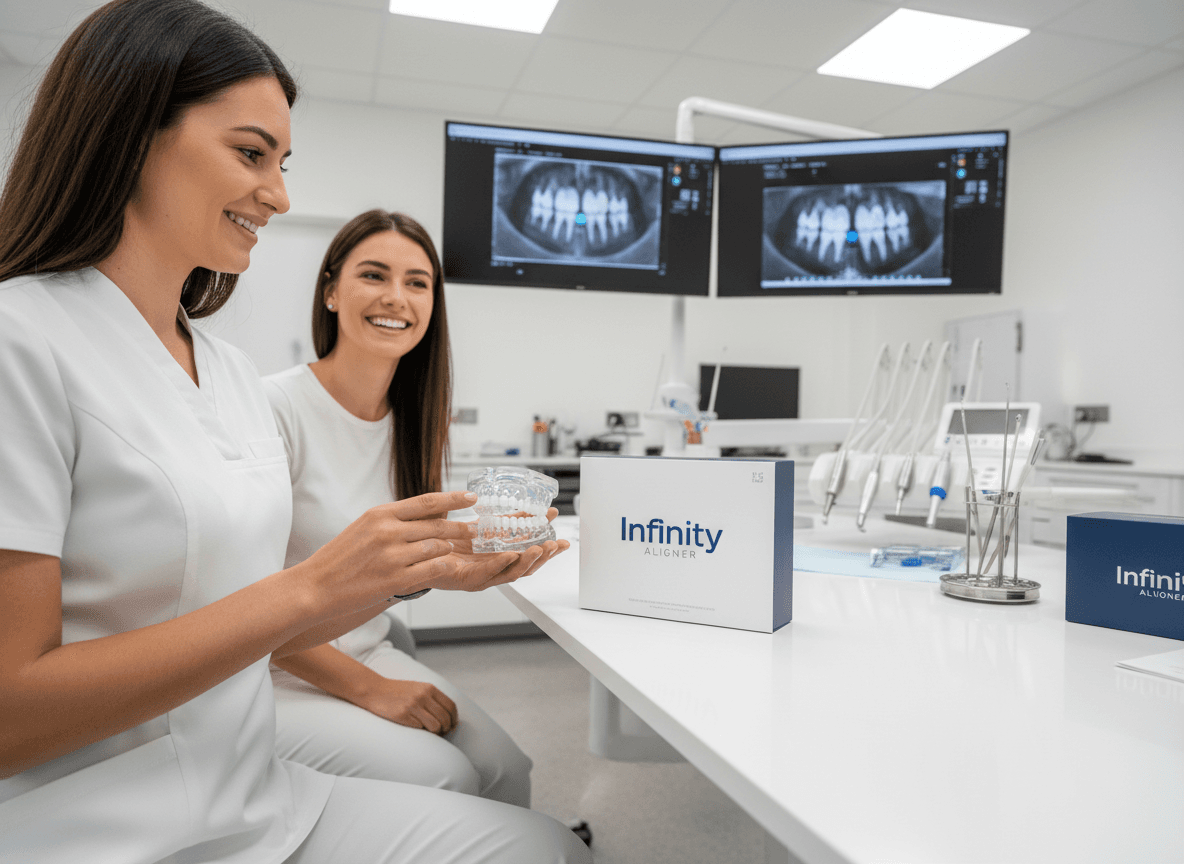
Geometry, positioning, AI planning and bonding protocols for orthodontic attachments: the complete clinical guide to mastering attachments in clear aligner therapy.
In the collective imagination, invisible orthodontics is reduced to a series of transparent trays exerting constant pressure on the teeth. Yet the polymer plate alone, however technological, meets physical limits when faced with complex movements: axial rotations, intrusions, root control. This is where attachments come in — small composite resin reliefs bonded to the tooth surface, acting as true biomechanical anchor points. Far from being simple aesthetic additions, they are the indispensable levers that transform the compression of an aligner into a precise and predictable tooth movement.
1. Why the aligner alone is not enough: physical limits
A clear aligner exerts its forces by enveloping the dental crown. This contact geometry is effective for simple translation movements (mesialisation, distalisation, mild expansion) but insufficient for movements requiring an oriented force couple or a fulcrum outside the crown axis. The most affected movements are:
- Axial rotations (particularly of premolars and canines): the aligner slides over the smooth crown surface without creating sufficient torque
- Intrusion (pushing a tooth apically into the bone): requires a vertical apical force impossible to generate by simple tray compression
- Root torque: moving the root without moving the crown requires a force moment that only a well-positioned attachment can transmit
- Controlled extrusion of incisors: the aligner tends to lose contact with the extruded tooth, rendering the force null without physical anchorage
2. Attachment biomechanics: converting compression into force couple
The biomechanical principle of the attachment relies on creating a geometric interference between the attachment relief and the corresponding recess engraved in the aligner. When the tray is in place, this interference generates a localised force whose direction and magnitude depend directly on the attachment's shape. By modifying the activation angle of the attachment, Infinity Aligner engineers can precisely orient the resulting force vector.
| Attachment type | Geometry | Generated force vector | Main indication |
|---|---|---|---|
| Vertical rectangular | Vertical block on buccal surface | Extrusion + inclination control | Incisors, canines |
| Horizontal rectangular | Horizontal block on buccal surface | Rotation + torque couple | Upper premolars |
| Activated bevelled (gingival) | Ramp inclined gingivally | Intrusion + apical couple | Anterior segment — open bite |
| Activated bevelled (occlusal) | Ramp inclined occlusally | Extrusion + coronal couple | Extruded incisors |
| AI-optimised (multi-surface) | Algorithmically calculated geometry | Multi-axial composite vector | Complex combined movements |
3. Digital attachment planning: the contribution of artificial intelligence
Manual attachment prescription by the practitioner — choosing the type, size and position of each attachment in the virtual setup — remains the norm in most aligner systems today. But AI is beginning to transform this step. Machine learning algorithms, trained on millions of treated cases, can now:
- Predict the expected expression rate of each movement without an attachment, and automatically trigger an attachment recommendation if this rate is insufficient
- Calculate the optimal attachment geometry (size, angle, height on the crown) to maximise expression while minimising periodontal tissue stress
- Position the attachment at the tooth's centre of resistance for bodily movement, avoiding unwanted tipping effects
- Automatically generate the necessary over-correction antagonists in the setup to compensate for the inevitable under-expression of orthodontic forces
4. Clinical bonding protocol: from preparation to finishing
The quality of bonding determines the effectiveness and durability of attachments throughout treatment. A poorly placed attachment — offset by just 1 mm from its planned position — can significantly alter the force vector and result in a movement different from that planned in the virtual setup.
- Step 1 — Cleaning and drying: prophylactic pumice polish (fluoride-free), air drying for 30 seconds
- Step 2 — Acid etching: 37% orthophosphoric acid for 15 seconds on enamel, thorough rinsing, drying
- Step 3 — Bonding application: thin layer of adhesive resin, light-curing for 10 seconds
- Step 4 — Template filling: the positioning template (provided with the kit) is filled with flowable composite in the attachment recesses
- Step 5 — Placement and light-curing: the template is pressed firmly onto the teeth and held, each attachment is cured for 20 seconds per surface
- Step 6 — Finishing: template removal, margin verification with mirror and probe, edge polishing to eliminate any composite excess
5. Aesthetic impact and patient comfort
Attachments undeniably reduce aligner discretion. A 1 to 2 mm composite relief on the buccal surface of an incisor is visible at close range. This is one of the trade-offs the practitioner must discuss honestly with the patient before treatment begins. Several elements can help limit the aesthetic impact:
- Use A1 or BL (optical white) composite shade rather than A2/A3 which yellow more quickly
- Position attachments preferentially on palatal or lingual surfaces when biomechanics allows
- Avoid buccal attachments on upper central incisors for aesthetically demanding patients
- Inform the patient that attachments are removed at end of treatment without leaving a visible mark on enamel
6. Attachment stability: preventing debonding
Attachment debonding during treatment is the most frequent and disruptive incident. It interrupts the expression of the targeted movement and, if not detected quickly, can lead to tracking failure. The most common causes are:
- Tooth surface contamination by saliva or blood during bonding (leading cause)
- Insufficient etching or too-short light-curing time
- Excessive occlusal forces on the attachment (premature contacts with the opposing tooth)
- Undiagnosed bruxism — clenching forces exceed the adhesive strength of the composite
- Poor composite selection: using a flowable that is too liquid without sufficient filler
7. Future developments: printed attachments and active surfaces
Coming years will see the emergence of attachments printed directly into the aligners — eliminating the chairside bonding phase and guaranteeing perfect positioning. Research teams are also working on nanoscale "textured" attachment surfaces to increase the friction coefficient between the attachment and the aligner wall, thus improving force transmission. These innovations could reduce the number of attachments needed per treatment by 30 to 40%, considerably simplifying the patient experience.
Conclusion
Attachments are far more than small composite reliefs — they are the physical link between digital planning technology and the biomechanical reality of tooth movement. Their clinical mastery — from setup prescription to chairside bonding and debonding monitoring — is what distinguishes a high-precision aligner treatment from simple aesthetic straightening. Infinity Aligner integrates this dimension into the training of every certified practitioner, ensuring that every placed attachment is there for a precise reason, in the right place, with the right geometry.
Infinity Aligner
Clinical & editorial team
More articles
How to Choose Clear Aligners in Tunisia
Clear Aligners vs Braces: Complete Comparison
How Much Do Clear Aligners Cost in Tunisia?
How Long Does Clear Aligner Treatment Take?
How to Clean and Care for Your Clear Aligners Daily
Clear Aligners for Teenagers: What Parents Need to Know
Gap Teeth & Diastema: Can Clear Aligners Fix Them?
Can You Play Sports with Clear Aligners?

3D Smile Simulation: How It Works and What to Expect
Orthodontic Relapse: Why Teeth Move After Treatment
Intraoral Scanner vs Traditional Impressions: What's the Difference?
Clear Aligners for Adults: Is It Ever Too Late?
Wisdom Teeth and Clear Aligners: Are They Compatible?

Clear Aligners: A Versatile Therapeutic Approach in Orthodontics

Orthodontics and Periodontal Health: What Every Patient Needs to Know
The Technology Behind Clear Aligners: From Design to Tray

How to Prepare for Your Orthodontic Consultation: 10 Questions to Ask
Bruxism and Clear Aligners: Can You Correct and Protect at the Same Time?

Class II Malocclusion and Clear Aligners: What Treatment Options Exist?
Clear Aligners and Dental Implants: Protocol, Timing and Clinical Cases
Digital Workflow and Aligner Biomechanics: The Advanced Practitioner Protocol
The Limits of Clear Aligners: Identifying Complex Cases Beyond Their Reach
Aligner Manufacturing: Thermoforming, 3D Printing and Polymer Science
Invisible Orthodontics in 2030: Predictive AI, Direct Printing and Active Materials
Smile Without Borders: The Price of Aligners Between Tunisia, Europe and Canada

The Smile Beyond the Mirror: The Profound Impact of Dental Alignment on Psychological Well-being
Tunisia: The New Eldorado of Digital Dentistry and Medical Tourism
Post-Orthodontic Retention: The Forgotten Step That Decides Everything
What You Can (and Cannot) Eat With Clear Aligners
Teeth Whitening and Clear Aligners: Can You Treat and Whiten at the Same Time?
TMJ and Clear Aligners: How Invisible Orthodontics Acts on Jaw Pain
The Different Types of Dental Retainer: A Complete Guide After Orthodontic Treatment
The hidden dangers of metal braces: what patients need to know
Root resorption: the silent risk of poorly managed orthodontic treatments

Orthodontics and cavities: how metal braces compromise dental hygiene

Orthodontic relapse: why teeth return to their original position

Braces and chronic pain: the underestimated impact on daily quality of life
Intraoral scanner vs conventional impressions: dimensional analysis and clinical implications
CAD/CAM digital workflow in orthodontics: from intraoral scanning to aligner fabrication
Deformation, shrinkage and cumulative errors: why the conventional impression chain compromises aligner precision
Intraoral Scanners 2025: Complete Technical and Metrological Comparison
Why Choose Infinity Aligner? The Complete Guide for Dental Practitioners
Composite Selection for Aligner Attachments: Mechanical Analysis and Clinical Protocol
TMJ and Malocclusion: Differential Diagnosis and Clinical Approach for the Practitioner
Travelling with Clear Aligners: The Complete Guide for Stress-Free Trips
The First Month with Aligners: What to Expect Week by Week
Pre-Prosthetic Orthodontics: Preparing the Site Before Implants or Veneers
Consult a certified dentist
Our 200+ certified partners in Tunis, Sfax, Sousse and the francophone zone welcome you.
Book a consultation