Smile Without Borders: The Price of Aligners Between Tunisia, Europe and Canada
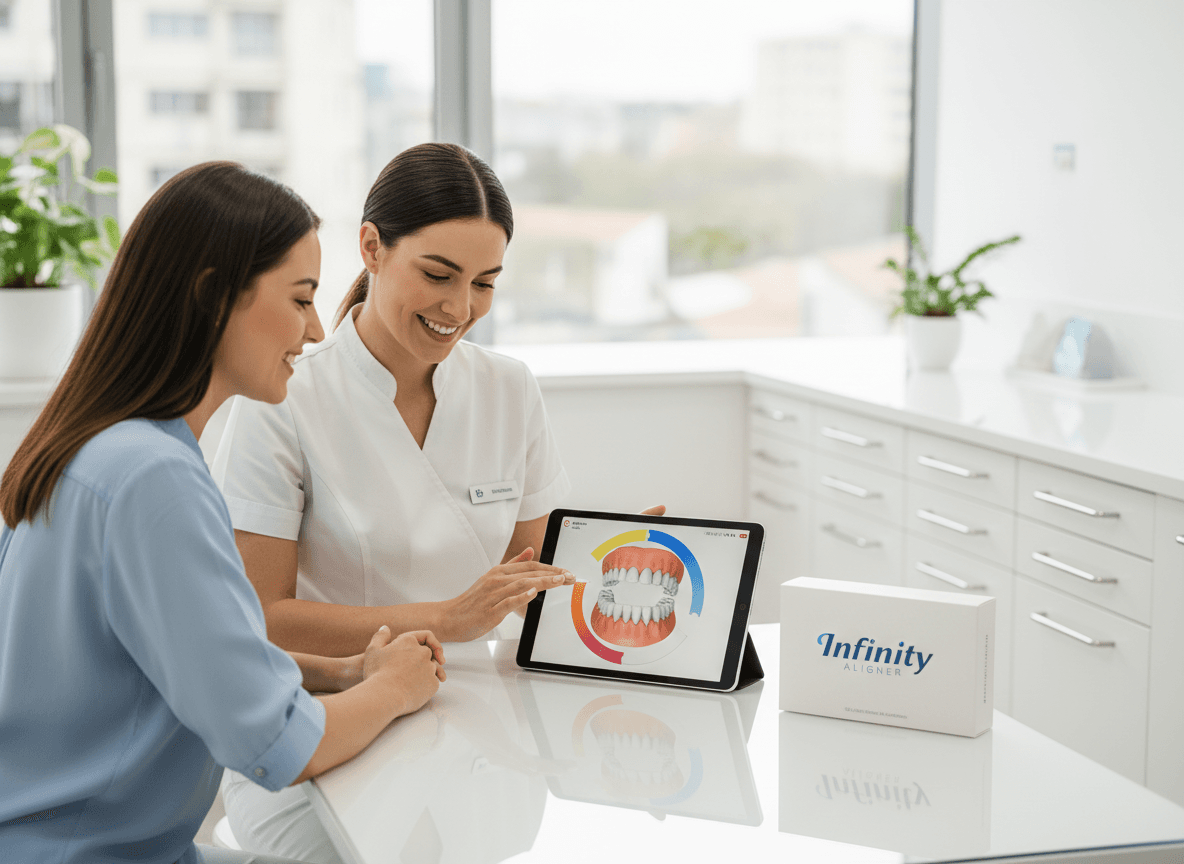
Detailed comparison of clear aligner costs in Tunisia, France, Belgium and Canada: prices in euros and Canadian dollars, quality of care and medical tourism opportunities.
Long perceived as a luxury solution reserved for an elite, clear aligner orthodontics has radically transformed the global dental care landscape. Combining aesthetics, comfort and digital precision, this technology has become the reference for correcting dental misalignments. Yet behind the appeal of this innovation lies a contrasting financial reality: treatment cost remains the main barrier for millions of patients. In this context, a complex geography of care has taken shape — and Tunisia has established itself as a key player.
1. The price comparison: rates by region and complexity
For an objective comparison, here are the price ranges observed in 2025 for a complete clear aligner treatment, all fees included (scan, 3D simulation, trays, monitoring and retention):
| Region | Mild case | Moderate case | Full case |
|---|---|---|---|
| 🇫🇷 France | €2,500 – €3,500 | €3,500 – €5,500 | €5,500 – €8,000 |
| 🇧🇪 Belgium | €2,200 – €3,200 | €3,200 – €5,000 | €5,000 – €7,500 |
| 🇨🇦 Canada | CAD 2,800 – 4,000 | CAD 4,000 – 6,500 | CAD 6,500 – 9,500 |
| 🇹🇳 Tunisia (Infinity Aligner) | 1,500 – 2,500 TND | 2,500 – 4,500 TND | 4,500 – 7,000 TND |
| 🇹🇳 Tunisia (EUR equivalent) | €450 – €750 | €750 – €1,350 | €1,350 – €2,100 |
Converting at the average 2025 exchange rate (€1 ≈ 3.3 TND), a complete treatment in Tunisia costs 3 to 4 times less than in France or Belgium, and up to 5 times less than in Canada. A gap that, for a francophone patient living abroad, can easily absorb the cost of a flight and stay in Tunis.
2. Why such a price gap? The economic reasons
The price difference does not reflect a difference in quality. It is explained by a fundamentally different cost structure:
- Labour costs: a qualified dentist's salary in Tunisia represents approximately 20 to 30% of that of their French or Canadian counterpart, at equivalent training and skills
- Fixed practice costs: rent, equipment, social charges — all significantly lower in Tunisia
- Local manufacturing: Infinity Aligner produces its trays in Tunisia, eliminating import costs and logistics delays of foreign brands
- Favourable taxation: the medical sector benefits from reduced VAT and health service export incentives
- No intermediary margins: absence of national distributors imposing margins on orthodontic consumables
3. Quality of care: same technology, same protocol?
This is the legitimate question every patient asks before taking the plunge. The answer is yes — provided you choose a certified practitioner working with a rigorous digital planning system. Certified Infinity Aligner dentists use exactly the same tools as their European counterparts:
- Latest-generation intraoral scanner (Medit, 3Shape, iTero)
- 3D planning software with final smile simulation
- Trays manufactured in certified medical thermoplastic (BPA-free, CE)
- Follow-up protocols aligned with AAO (American Association of Orthodontists) recommendations
- Ongoing training and annual recertification of partner practitioners
4. Medical tourism in Tunisia: a mature industry
Tunisia welcomes tens of thousands of European and Canadian patients every year for dental care. This sector, structured since the 2000s, has reached remarkable maturity. For clear aligner treatment, most patients organise their stay in two to three visits spaced a few months apart:
- Visit 1 (2 to 3 days): initial consultation, scan, 3D simulation, treatment plan validation
- Remote waiting period (10 to 14 days): tray manufacturing in Tunis
- Tray delivery: secure postal shipment to the patient's home in Europe or Canada
- Remote monitoring: mobile app follow-up and video calls with the practitioner
- Optional visit 2: mid-treatment check or refinement delivery
5. The complete calculation for a francophone patient in Europe
| Expense item | Estimated amount |
|---|---|
| Infinity Aligner treatment (moderate case) | €750 – €1,350 |
| Return flight Paris–Tunis | €80 – €200 |
| Hotel 3 nights (partner hotel) | €120 – €200 |
| Transfers and meals | €50 – €100 |
| TOTAL TUNISIA | €1,000 – €1,850 |
| Equivalent treatment in France | €3,500 – €5,500 |
| Net saving | €1,650 – €3,650 |
6. Precautions to take before committing
- Verify the practitioner's certification: a certified Infinity Aligner dentist is listed in the official network directory
- Request a 3D simulation and detailed quote before any financial commitment
- Ensure remote monitoring is organised from the outset (monitoring app, direct contact with the practitioner)
- Be wary of "all-inclusive" offers at rock-bottom prices with no guarantee of clinical follow-up
- Verify that trays are manufactured with CE/FDA certified materials
Conclusion: a real opportunity, an informed decision
The price gap between Tunisia, Europe and Canada is not a sign of inferior quality — it reflects a different economic structure that makes accessible to everyone what Western markets still reserve for a minority. For the informed francophone patient who chooses a certified practitioner, a rigorous digital planning system and organised remote monitoring, Tunisia represents an opportunity without compromise on quality. Infinity Aligner was built on this conviction: orthodontic excellence should not be a geographical privilege.
Infinity Aligner
Clinical & editorial team
More articles
How to Choose Clear Aligners in Tunisia
Clear Aligners vs Braces: Complete Comparison

How Much Do Clear Aligners Cost in Tunisia?
How Long Does Clear Aligner Treatment Take?
How to Clean and Care for Your Clear Aligners Daily
Clear Aligners for Teenagers: What Parents Need to Know
Gap Teeth & Diastema: Can Clear Aligners Fix Them?
Can You Play Sports with Clear Aligners?

3D Smile Simulation: How It Works and What to Expect

Orthodontic Relapse: Why Teeth Move After Treatment
Intraoral Scanner vs Traditional Impressions: What's the Difference?

Clear Aligners for Adults: Is It Ever Too Late?
Wisdom Teeth and Clear Aligners: Are They Compatible?

Clear Aligners: A Versatile Therapeutic Approach in Orthodontics
Orthodontics and Periodontal Health: What Every Patient Needs to Know
The Technology Behind Clear Aligners: From Design to Tray
How to Prepare for Your Orthodontic Consultation: 10 Questions to Ask
Bruxism and Clear Aligners: Can You Correct and Protect at the Same Time?

Class II Malocclusion and Clear Aligners: What Treatment Options Exist?
Clear Aligners and Dental Implants: Protocol, Timing and Clinical Cases
Digital Workflow and Aligner Biomechanics: The Advanced Practitioner Protocol
The Limits of Clear Aligners: Identifying Complex Cases Beyond Their Reach
Aligner Manufacturing: Thermoforming, 3D Printing and Polymer Science
Invisible Orthodontics in 2030: Predictive AI, Direct Printing and Active Materials
Attachments in Invisible Orthodontics: The Silent Levers of Biomechanics

The Smile Beyond the Mirror: The Profound Impact of Dental Alignment on Psychological Well-being
Tunisia: The New Eldorado of Digital Dentistry and Medical Tourism
Post-Orthodontic Retention: The Forgotten Step That Decides Everything
What You Can (and Cannot) Eat With Clear Aligners
Teeth Whitening and Clear Aligners: Can You Treat and Whiten at the Same Time?
TMJ and Clear Aligners: How Invisible Orthodontics Acts on Jaw Pain
The Different Types of Dental Retainer: A Complete Guide After Orthodontic Treatment
The hidden dangers of metal braces: what patients need to know
Root resorption: the silent risk of poorly managed orthodontic treatments

Orthodontics and cavities: how metal braces compromise dental hygiene

Orthodontic relapse: why teeth return to their original position
Braces and chronic pain: the underestimated impact on daily quality of life
Intraoral scanner vs conventional impressions: dimensional analysis and clinical implications
CAD/CAM digital workflow in orthodontics: from intraoral scanning to aligner fabrication
Deformation, shrinkage and cumulative errors: why the conventional impression chain compromises aligner precision
Intraoral Scanners 2025: Complete Technical and Metrological Comparison
Why Choose Infinity Aligner? The Complete Guide for Dental Practitioners
Composite Selection for Aligner Attachments: Mechanical Analysis and Clinical Protocol
TMJ and Malocclusion: Differential Diagnosis and Clinical Approach for the Practitioner
Travelling with Clear Aligners: The Complete Guide for Stress-Free Trips
The First Month with Aligners: What to Expect Week by Week
Pre-Prosthetic Orthodontics: Preparing the Site Before Implants or Veneers
Consult a certified dentist
Our 200+ certified partners in Tunis, Sfax, Sousse and the francophone zone welcome you.
Book a consultation